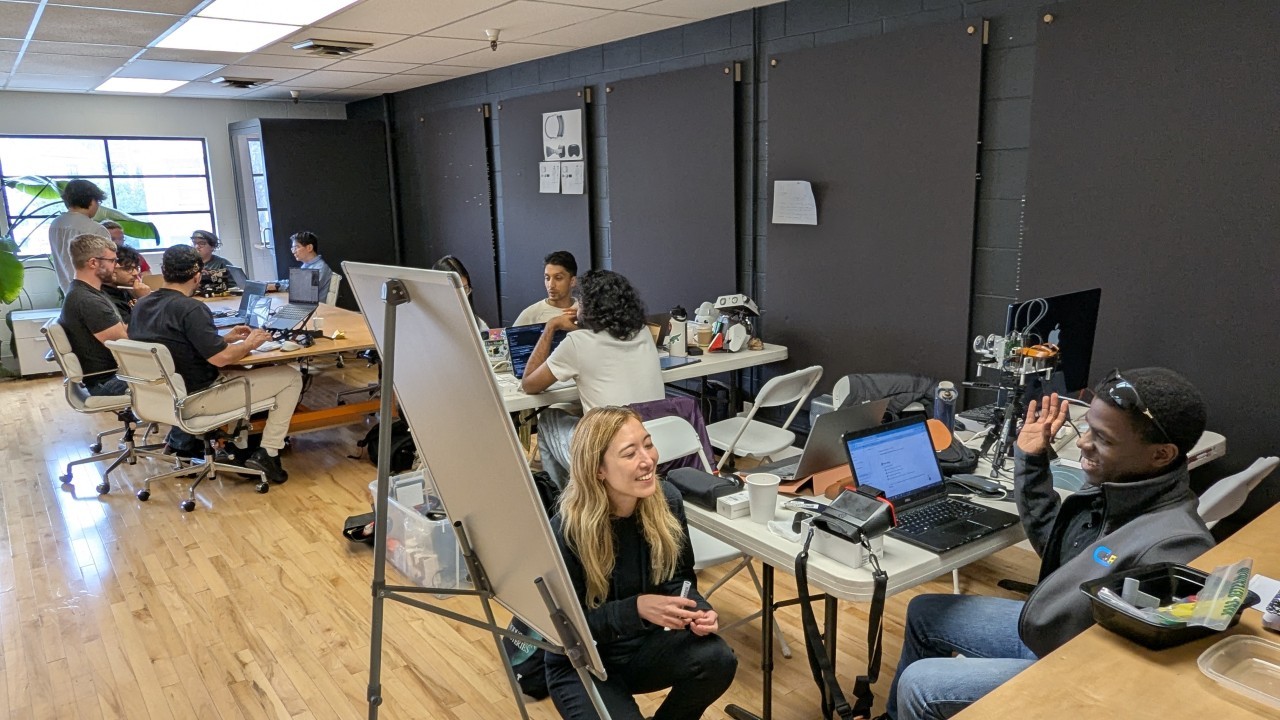
This is a recap of the 30 day worldwide hack exploring what's possible beyond the AI chat with any window application craze and into new physical product and hardware development in partnership with Boost VC , Flux , PamirAI and other supporters.
In the last couple of years, we've been hosting these in SF for weekend sprints across robotics and lab automation, global health, and more. This summer we wanted to explore how to support builders from different cities partnering with Hardware Meetup.
So we hosted a 30 day hybrid challenge: one part in person across different cities, and many parts virtual for all with community office hours, feedback channels, build in public support, and demos.
We had 200+ sign ups, 100+ builders join in person, 30 days to make as much progress as possible, and 8 teams make it to final demo with many great partners to make it happen.
Why this matters
There's a lot of support for software in community and not as much for hardware, physical products, and robotics. Building hardware can be super isolating, especially at the earliest stages. We want to help people meet early team members, build lasting relationships, and regain optimism for building physical products.
Hardware requires a global community between global design and manufacturing partners and the geographic distribution of where the problems are located. It feels a bit paradoxical to have a virtual community building physical hardware, but the opposite of no community support seems worse than the tension.
Advancements in foundation models can help accelerate many parts of the development and iteration process, like vibe coding firmware, or unlock new applications, like smart products that can take in context and talk back. We're in early days of these new tools like Claude Code. Exploring what's possible in community is both a forcing function (ie. demo by Sunday), and also a multiplier to see how others are building.
Below are the final demos. Connect with the teams directly if you want to help support their next steps!
1) Neo AGF — a hackable BCI you can actually build with
A “Whoop for the brain”: track focus, gently stimulate, and stream real-time EEG. In 30 days they assembled sensors, 3D-printed headsets, shipped Bluetooth EEG streaming, launched a live brain viz web app, and got their first pre-orders. Next up: ship 100 dev units in ~60 days and launch as a developer kit.
Team: Patrik Šlachta Massimo Bardetti Rohit Korrapolu Chaitanya Polapragada @Shreeram
2) Circuit Synth — design PCBs with Python (and an agent)
A Python library that helps establish correct connections in KiCad, with an agent that builds circuits. They're exploring how Claude code can establish different subagents to go from schematic to manufactured board with standardized components as code.
Team: Shane Mattner Varun Raghavendra Kumuda Subramanyam
3) Fable Engineering — “Zero,” a playful home robot
An open-design companion robot inspired by Disney BDI droids: autonomous nav, vision, speech, and an app for programmability. In 30 days they printed parts, finished wiring, and trained an RL motion policy; early signal includes 150 parents on the waitlist and 250k+ social reactions, with a sub-$500 target.
Team: Pierre-Louis Soulié Kush Dasadia
4) Smart Case — breathalyzer + health sensors in your phone case
Angel’s case integrates a breathalyzer, body temp, and UV sensors to make safe choices the default (addressing 13k U.S. drunk-driving deaths annually). Recent progress: ribbon-cable PCB rev for signal integrity, a BAC algorithm, and early AI for time-to-sober predictions. Model: ~$10–15 COGS, $70 retail, exploring public transit partnerships.
Team: @Angel
5) USV — low-cost ocean data from an unmanned surface vehicle
Eduardo’s coastal USV collects environmental and bathymetric data so ports and fish farms stop guessing. In the last 30 days, he made progress on the winch and explored path to first customer.
Team: @Eduardo
6) Amygdala Modulation — a neuro-wellness device for stress hijacks
A portable, non-invasive device targeting amygdala modulation via electromagnetic frequencies positioned as a drug-free alternative.
Team: Xavier (Weijia) Huang @lyndsey
7) Cuts — physical shortcuts for everyday AI
Sumedh’s pocketable, gesture-activated device captures quick context (e.g., outfits), sends to AI, and returns instant feedback—think “AI on your mirror” to build a digital closet. He's exploring connection to physical, real world context, and looking at how to connect to thrift store experiences.
Team lead: Sumedh Supe
8) Vectometra — studio-grade motion capture without the studio
Nikhil’s lightweight, camera-free wearable targets sub-millimeter precision and <50g per unit. It aims to be orders-of-magnitude cheaper than optical rigs, with linear cost per joint and a software subscription.
Team lead: Nikhil Dubey
Debrief
What went well: community across multiple locations, shared experiences from builders with different backgrounds, different problems tackled across industries and geographies, access to the latest in hardware and software for hardware, and awesome mentors coming in each step of the way to support teams.
What can be improved for the next one: better onboarding for team making at first step, more in city support for local hacks, more targeted tracks, and more builders!
Thank you to our partners and supporters!
It takes a community to support early hardware teams like this
Thank you to Nate Padgett Jace Martin (Seattle) Paul Vizzio, PE (New York) and Hardware Meetup for supporting the SF, NYC, Seattle communities to make this possible across cities.
Thank you to Emily Yu and the Boost VC team for helping seed optimism for early builders and supporting them on Day 1
Shout out to Lance Cassidy Ryan Fitzgerald Nicolas Tzovanis and the Flux team for supporting builders with their new AI co-pilot for PCB design and development process
Thank you to Tianqi Ye and PamirAI team for getting new boards in the hands of users
Shout out to Vinny Pham for bringing XREAL glasses along for people to build with
Thank you Nate Padgett and the Studio 45 team for continuing to support build weekends like this in SF.
Thank you to Patrick Astarita for leading NY's Hack and Andrew Rose and the Fractal Tech community for supporting build opportunities.
Shout-out to Dylan Holland for holding it down in Seattle and Steven Dourmashkin and the Chiplytics team for hosting. h/t to @leon zhang
Thanks for mentors who came in for feedback Nick Grafakos, Emily Yu , Yash Oza , Jeremy Kuempel Ryan Fitzgerald
Shout-out to judges Daria Palenova Jordan White + Nima Zeighami
Want to be the first to hear about future opps?
👉 Sign up for our weekly community updates on substack.