"It is truly breathtaking how quickly you can create a functioning demo." — Tad, Sr. Automation Specialist, Exelixis
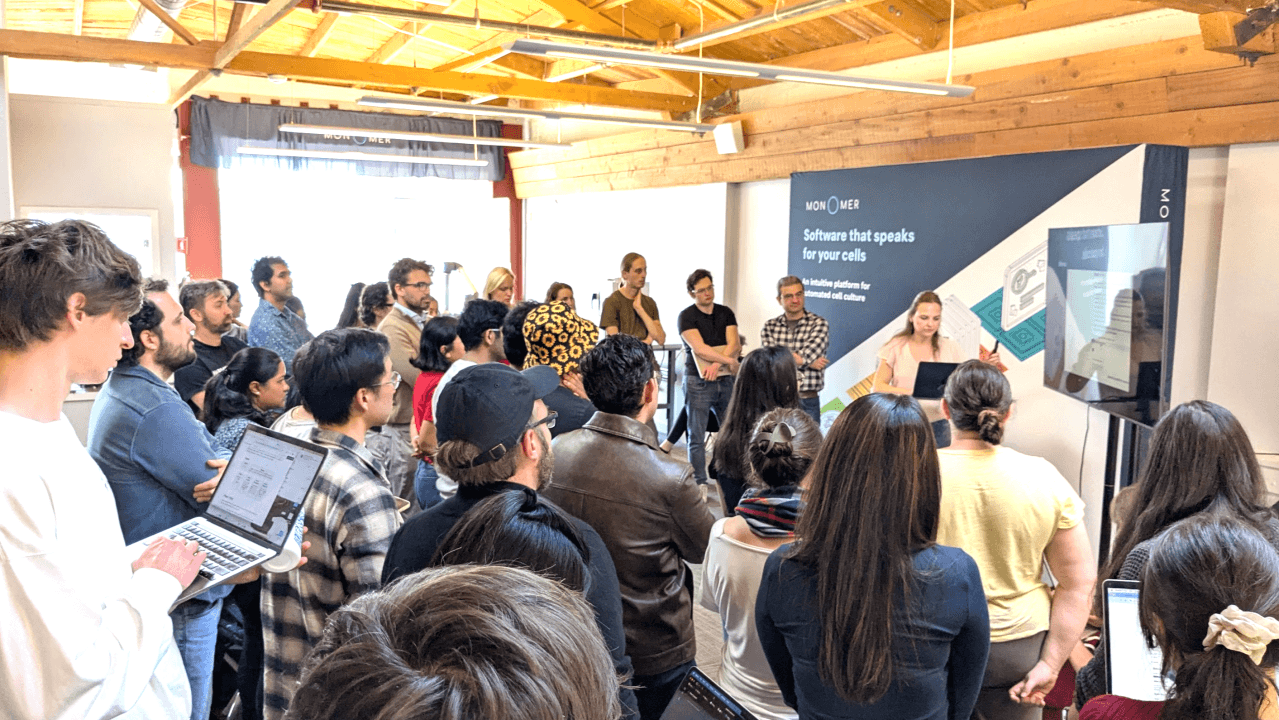
We had 100+ people with different backgrounds, including scientists, automation engineers, software developers and researchers all come together to ship prototypes across three AI and robotic tracks at Monomer Bio .
Every week there are new advancements in AI, like Karpathy's Autoresearch releasing a swarm of 100 agents to optimize any code. And every week, it seems like it's harder and harder to actually keep up with the latest tools.
That's one inspiration for an event like this. Bring the latest AI tools together with the latest hardware and fastest growing bacteria cells to show what's possible. Jimmy, CEO of Monomer, framed it as "The Homebrew Computer Club for Lab Automation." Rather than garage meetups, the Monomer team graciously hosted everyone out of their lab with access to the robotic workcell. We also had other great partners join.
In 24hrs, the top teams did 3 end to end experiments with bacteria cells on the workcell and developed natural language interfaces to robotic arms starting to automate T flask tasks.
Before we jump into the projects, let's talk about the set up.
The Setup: MCP-native, agent-first, cells included
The moment that stuck with me most was programming the workcell through Monomer Bio's MCP integration. Natural language to a fully specified liquid handling workflow in about 5 minutes. Something that would normally take the better part of a day -- if not more ! 🤯 - Arne, Co-founder @ Precision Discovery Systems
The biggest evolution from our October hack was the tooling layer. Monomer Bio 's workcell was fully accessible via MCP, meaning teams could programmatically control incubation, media mixing, media changes, and plate reading through natural language and AI agents.
Elnora provided the experimental reasoning layer suggesting media formulations, analyzing results, and expanding the search space beyond what teams would have considered on their own. Everyone started the day in Elnora and in Claude Code.
There were three tracks:
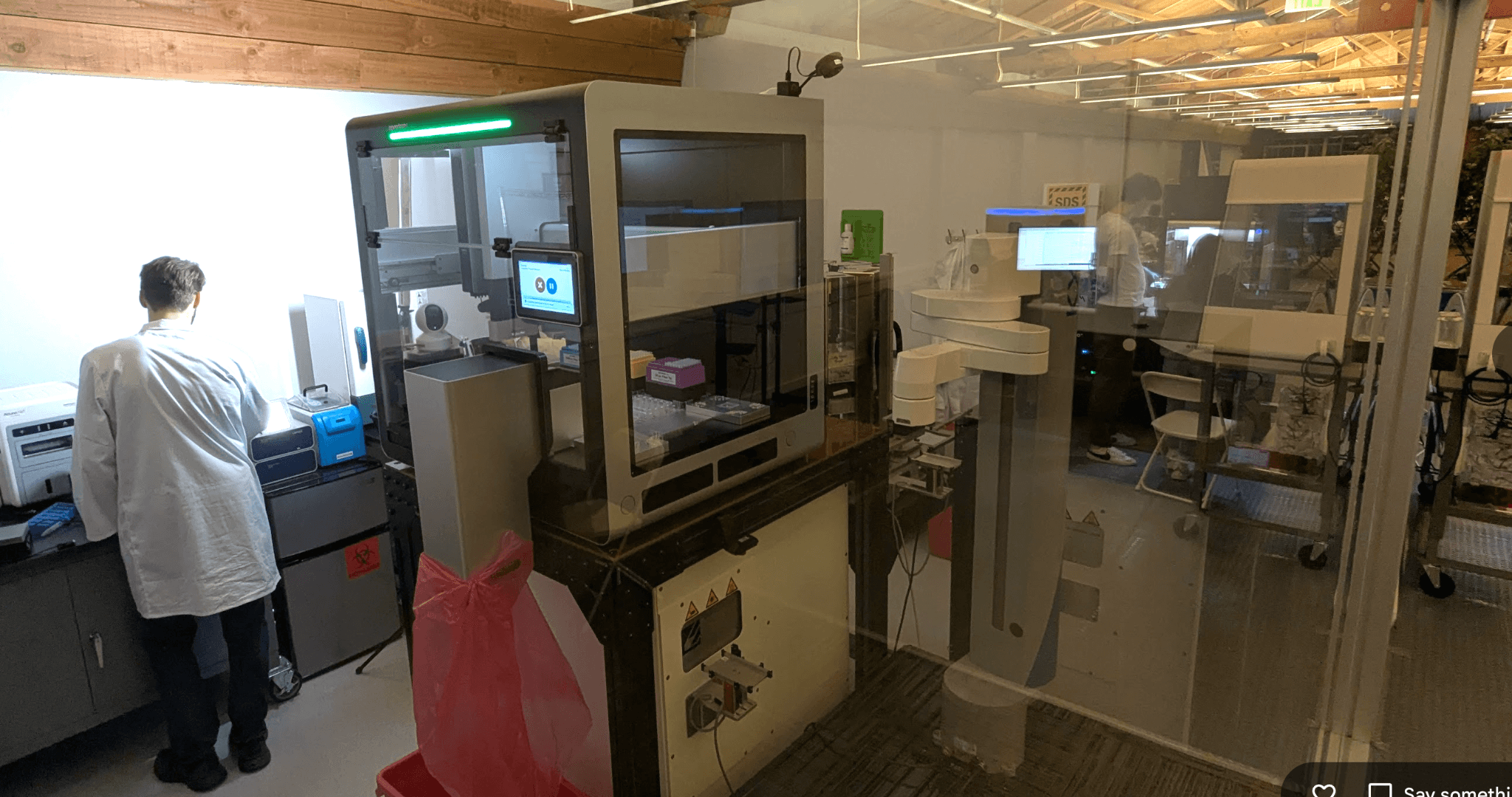
1. AI Agents on Monomer Bio robotic workcell: What 3 media components are most impactful to optimize? What dilution ranges should we try? Is a DOE appropriate or a different strategy given the limitations of your experimental setup? What media components cause precipitation and is there a way to design against that? The workcell also had Opentrons Labworks Inc. Flex, Liconic incubators, and Tecan plate readers.
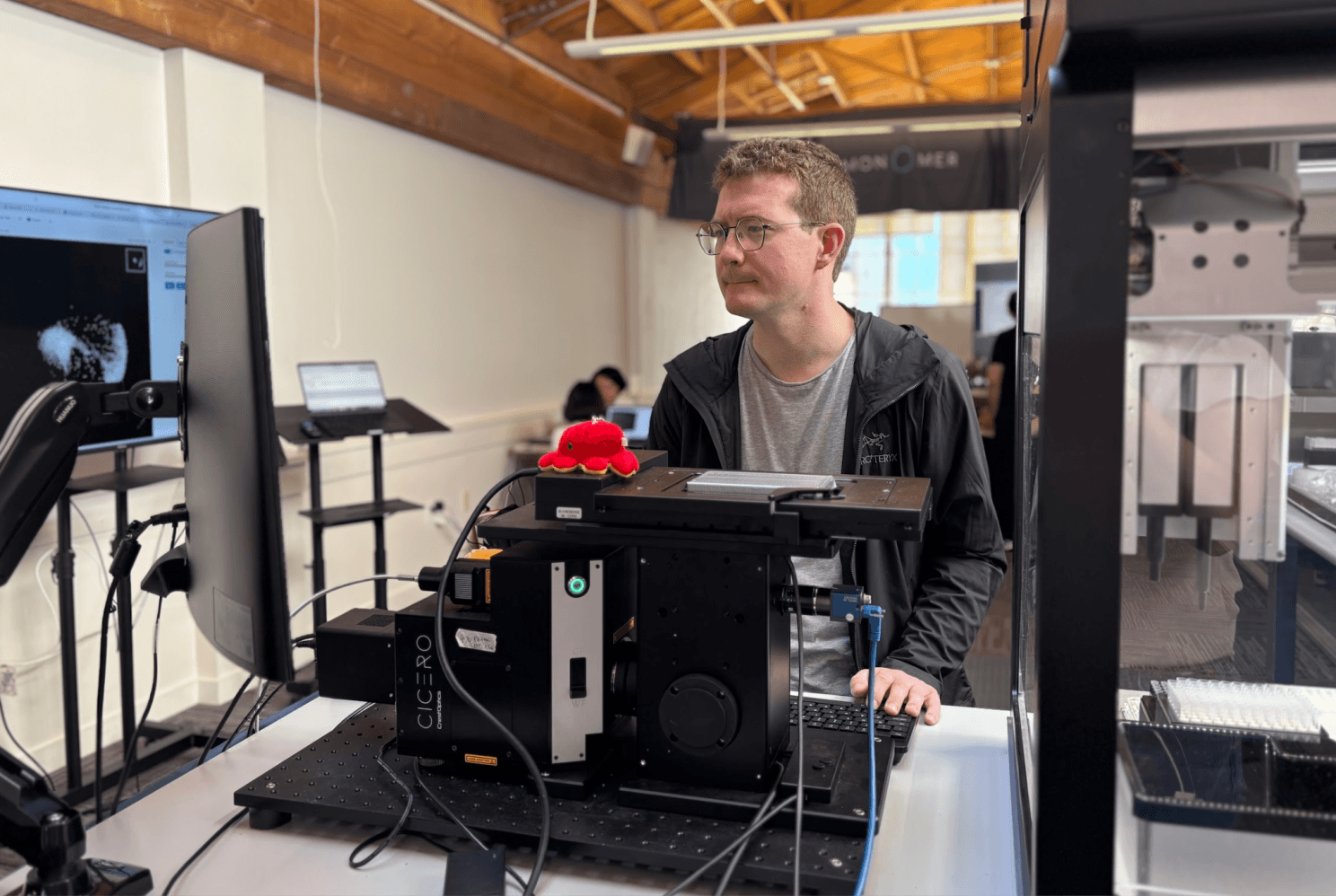
2. Computer Vision with Cephla 's Squid Microscope: What are best practices in generating monoclonal cell lines through dilution and seeding with liquid handlers? How long does it take for a cell to settle to the bottom of the well before you can take images?
@Monomer Bio's cloud based culture monitor for visualizing images across wells and time, uploading annotations and comments from AI and humans, down selecting to wells with single beads, and exporting picklists.
We also had an Opentrons Labworks Inc. OT-2 running PyLabRobot for liquid handling.
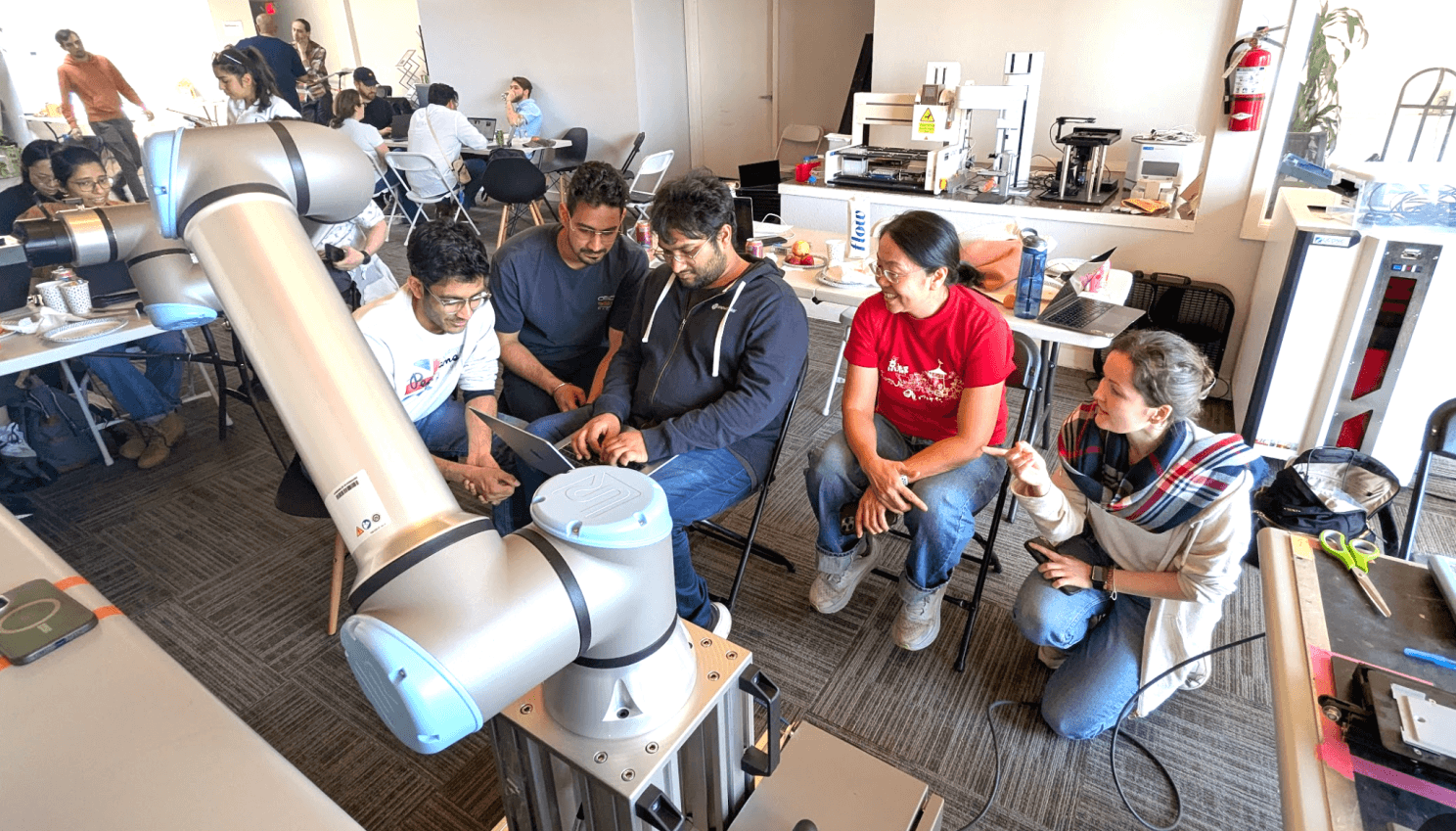
3. Physical AI: What pipetting techniques might affect growth when growing in T-Flasks? What is good sterilization technique for handling flasks? Olympus Controls provided a UR12e robotic arm for physical manipulation.
And the cell line for Track A was vibrio natriegens, the fastest growing organism on the planet, courtesy of Novel Bio with their NBx Cyclone strain. Tracks B and C worked with beads (as cell stand-ins for cloning workflows) and iPSC culture in T-flasks, respectively.
The 7 Projects Built + Shipped in 24hrs
"Our architecture sat at the intersection of robotics hardware, agent reasoning, and vibe coding. I had so much fun." - Aleksandra Denisin, Ph.D., Principal PM for Lab Automation @ Genentech
1. InstaLab (🏆 Best Overall)
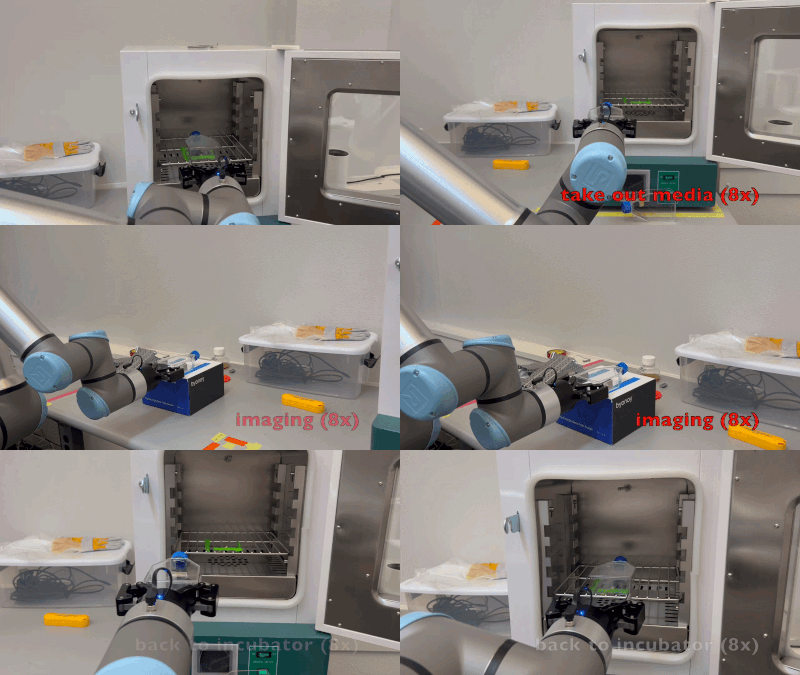
Team: Ambuj Agrawal, Fiona C. , Dhruv Agarwal , Julia Jia , Anne Baldwin , Aleksandra Denisin, Ph.D. , Reed Kelso , Mehul Arora , Dale Herzog
Problem: iPSC culture across multi-day cycles in T-flasks requires constant manual intervention, and researchers don't trust black-box automation with their cells.
Solution: CellPilot is an AI orchestration agent that bridges a scientist and a UR12e robotic arm for closed-loop iPSC culture. CellPilot doesn't just follow scripts. It analyzes microscopy images, consults Elnora for protocol decisions, and reasons in real time: cells too dense triggers a harvest, too sparse requests more incubation, contamination detected alerts the scientist immediately. Critically, it presents plans for human approval and explains its reasoning, removing the trust barrier that keeps researchers from handing off to automation. The team even started building a digital twin framework for cross-lab scalability.
2. Cereal Delusion 🤓 Best Scientific Insight
Team: Lucas Mair , Di Hu, PhD , Eric Hobson , @Louise T. , Cindy C. , Jonathan Klonowski, PhD, @Weicheng Li
Problem: Single-cell cloning is tedious and wasteful — too many empty wells, too many multi-cell wells, and too much manual QC.
Solution: An open-source, AI-assisted closed-loop system for single-cell cloning. It estimates cell concentration, performs optimal dilution and plating on the OT-2, images with the Cephla microscope, classifies wells using ML (empty / single / multiple / uncertain), iteratively fills empty wells, and enables human-in-the-loop QC through Monomer's Culture Monitor. The goal: maximize single-cell wells while minimizing wasted consumables and manual labor.
3. CellAi ✨ Best Demo
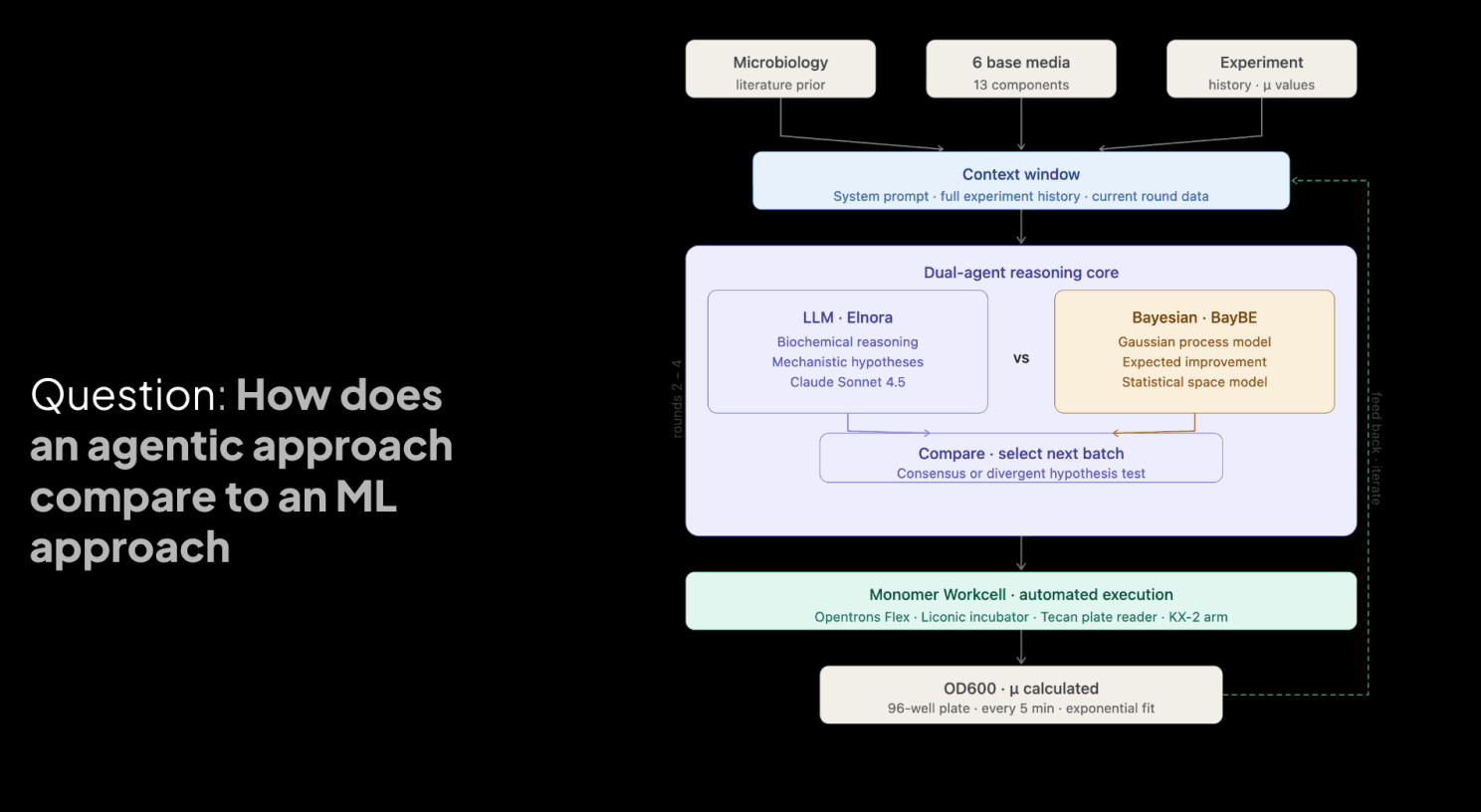
Team: Kateryna Stepurska, Arne Vandenbroucke, Slava Rudenko, Marie-Batisse Heite , Joe Davis, Zoey Huang , Razvan Valentin Marinescu
Problem: Moving from experimental data to the next experimental iteration still requires a human scientist to interpret, reason, and reprogram.
Solution: An agentic closed-loop system that interprets plate reader data, reasons about what the results mean for media optimization, and programs the robot to execute the next iteration. The team focused on making the reasoning step explicit and auditable.
4. ViNatX
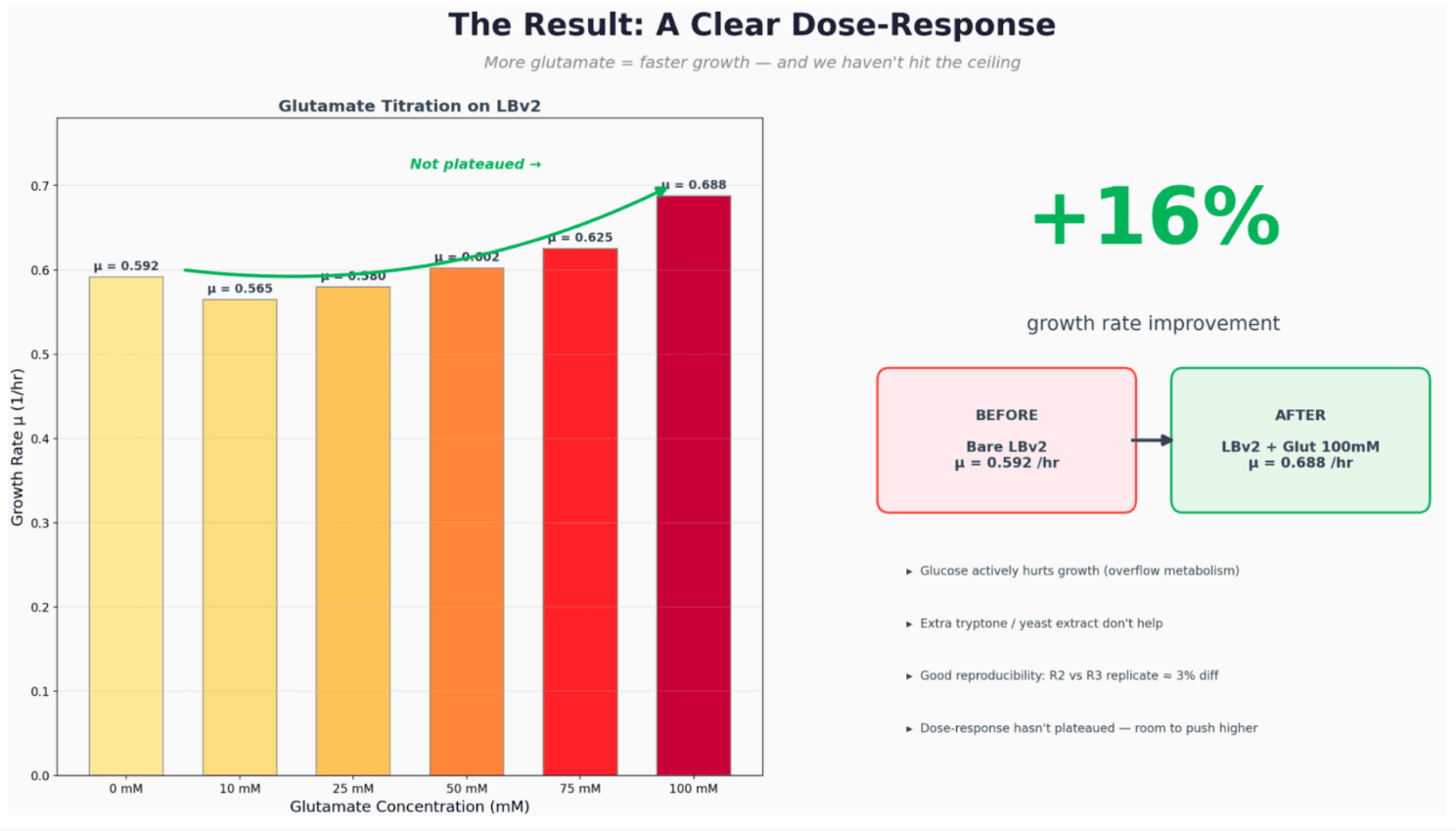
Team: Julia Gross, Tanisha Shiri, Juan Sebastian Reyes Davila, PhD, Ashton Trotman-Grant, Raul Molina
Problem: Optimizing growth media for Vibrio natriegens requires exploring a huge combinatorial space of nutrients, supplements, and concentrations.
Solution: An autonomous pipeline using Elnora and Claude Code to ideate media conditions, and Monomer's workcell to execute. They ran a head-to-head between classical Bayesian optimization (using the BayBE package) and LLM-driven experimental design with Elnora. They tested different seeding densities, defined media conditions, and glucose/MOPS/nitrogen supplementation. One Elnora-predicted condition produced noticeably higher growth than anything else on the plate.
5. Culture Shock
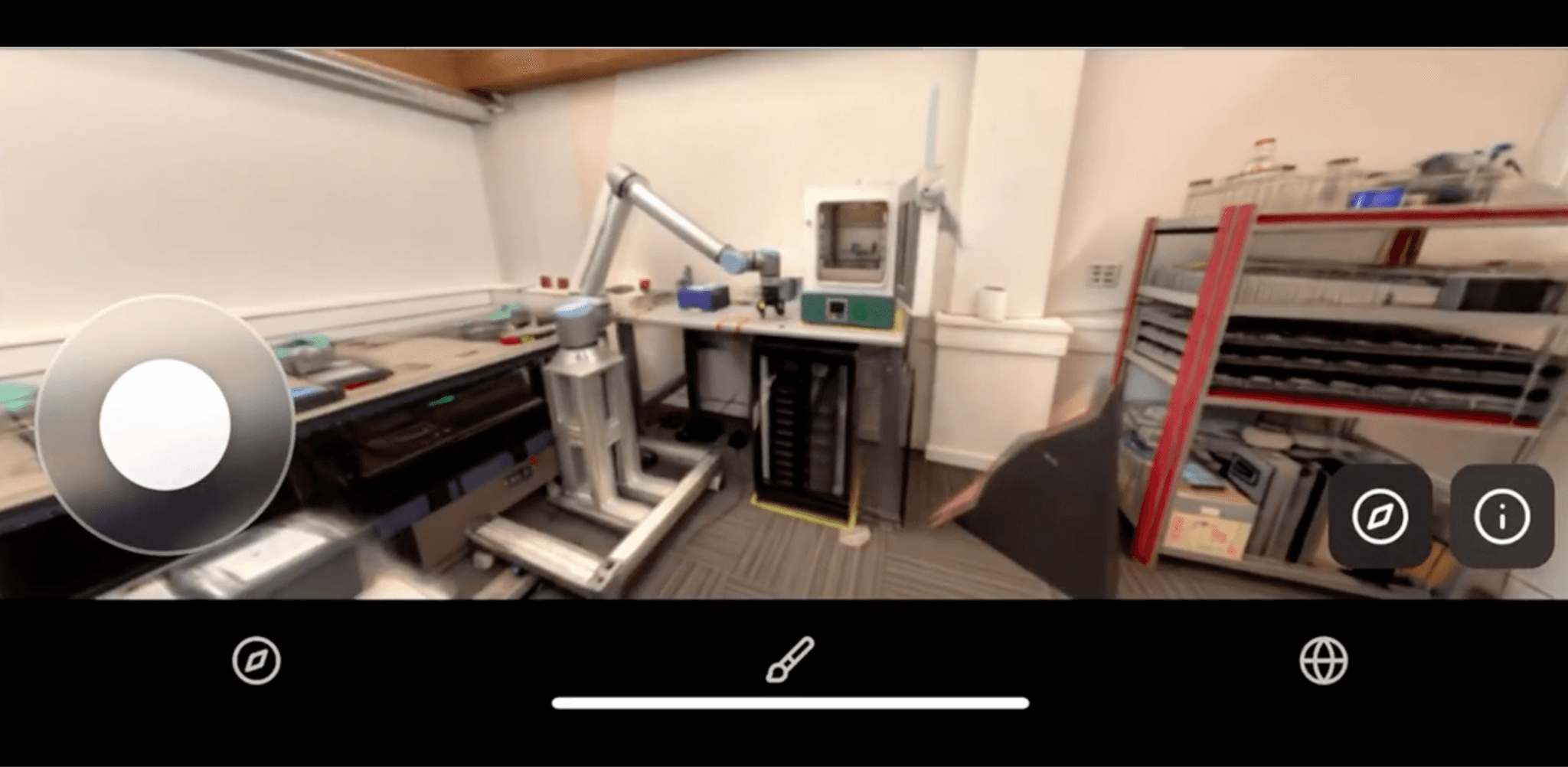
Team: Feifei Duan, Dale Herzog, Grace Lee, Rachel Lee, Betool Mohsen, Jaee Shah, Zac Builta
Problem: Cell culture automation systems lack true closed-loop intelligence. They execute but don't adapt.
Solution: A closed-loop cell culture automation system powered by Elnora AI. The system integrates experimental design, robotic execution on the workcell, and AI-driven analysis to iteratively refine media conditions without manual intervention.
6. LabFlow AI
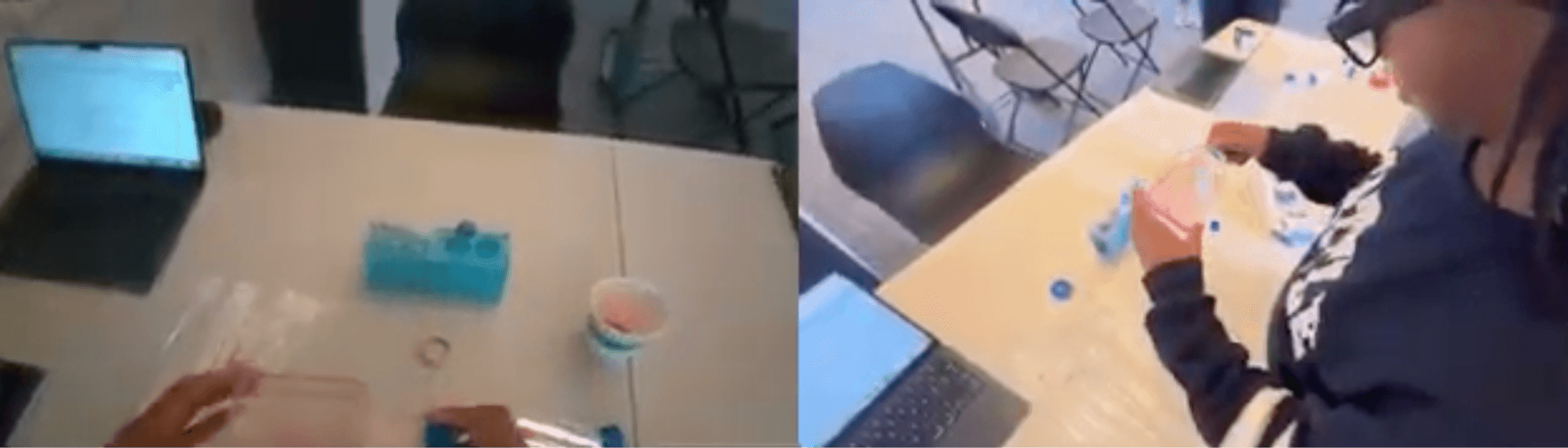
Team: Eugene Nadyrshin, Philip Thomas, Richard Luna , Shaneice Mitchell, Ph.D. , Swethkamal Kalyanaraman
Problem: Implicit knowledge, the small adjustments and techniques experienced operators use, gets lost, causing protocol drift and making investigations harder when things go wrong.
Solution: LabFlow AI uses vision-language models to observe operator execution and convert it into actionable, documented steps. This captures tacit knowledge, prevents drift across operators, and reduces investigation overhead in clinical, production, and research environments.
7. Classify AI
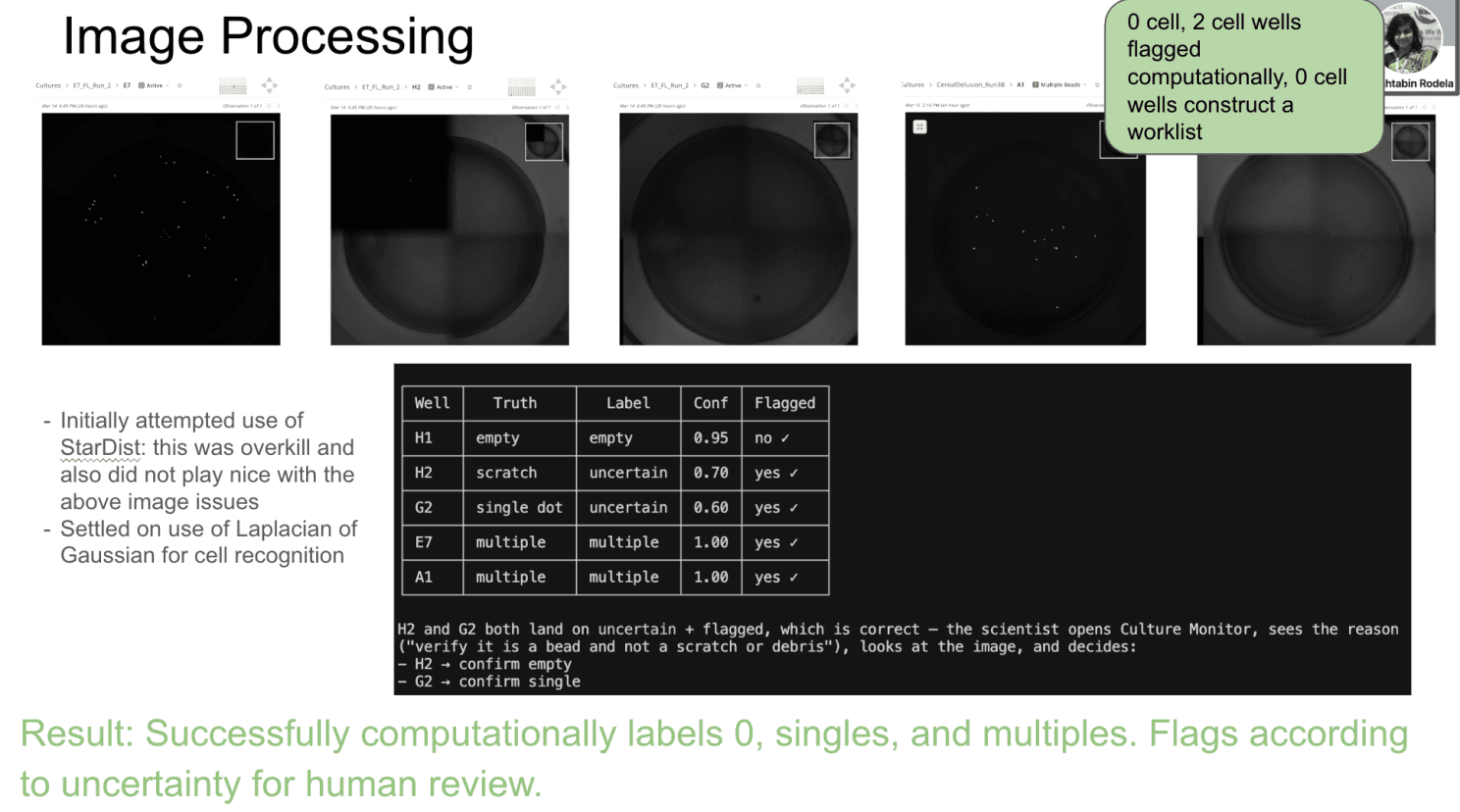
Team: Tad Ogorzalek, @Rodena, @Keyvan, Azadeh Mostafavi
Problem: Getting exactly one cell per well in a 96-well plate is a probabilistic challenge — and wasting plates on failed attempts is expensive.
Solution: An iterative single-cell seeding workflow where each well gets multiple attempts. After each liquid handling run, wells are imaged on the Cephla Squid, images are pulled from Monomer Culture Monitor, wells are flagged by classification, a new worklist is constructed, and another round launches. Repeat until plate coverage is maximized.
What's new now in 2026 v. before
Five hacks in, a few things stand out. The tooling has crossed a threshold. MCP integration means the gap between "I have an idea for an experiment" and "the robot is running it" collapsed to minutes for several teams. That's not incremental. That's new accessibility.
The teams are getting more interdisciplinary. We had automation specialists from pharma, ML researchers, roboticists, wet lab scientists, and software engineers all building together. The projects reflected that range. LabFlow AI came from a completely different angle than CellAi, but both are pushing the field forward.
These 24hrs are a starting point for more accelerated design and running of high throughput experiments.
Thank you to everyone who made this possible!
Host: Monomer Bio — Jimmy Sastra, PhD , Carter Allen , Turner Allen , Will P. and the entire team for opening their lab, designing tracks, supporting hardware, and building the MCP interface that made this level of automation accessible over a weekend. You are helping push the field forward with hands on community build experiences like this one.
AI Science Partners: Elnora — Carmen Kivisild, PhD for the experimental reasoning layer and all of the team support. Also, thank you for judging!
Hardware Partners: Opentrons Labworks Inc. for the Flex and community support. Thanks for being a great continual partner Shanin Barican!
Cephla for the Squid robotic microscope. Thanks Hongquan Li and @You for helping support the imaging track.
Olympus Controls — Aaron Bursten , Matthew Murphy , and Zara Shariff for the UR12e robotic arm and training.
Community Partners:
Cell Culture Collective, Inc. and Lauren Supko for reagents and lab consumables.
Plymouth and Lisa Wehden for supporting the builder community.
Bay Area Lab Automators and Luis Villa for championing events like this and supporting everyone to try new tools through building.
SF Hardware Meetup for connecting the hardware community to professional hackathons.
Worldwide Studios as a co-organizer for bringing ecosystems together to build together.
Judges: Nari Kang (Benchling), Alejandra Borda (Fifty Years), Carmen Kivisild, PhD (Elnora).
Mentors and supporters: Vivek Ramaswamy for helping teams throughout the weekend. Aldair E. Gongora for coming back to lend a hand. Rick Wierenga and PyLabRobot for the support.
Photos and videos by Brandon at Chromatyde
Up Next: AI Science Summit (June 16-17)
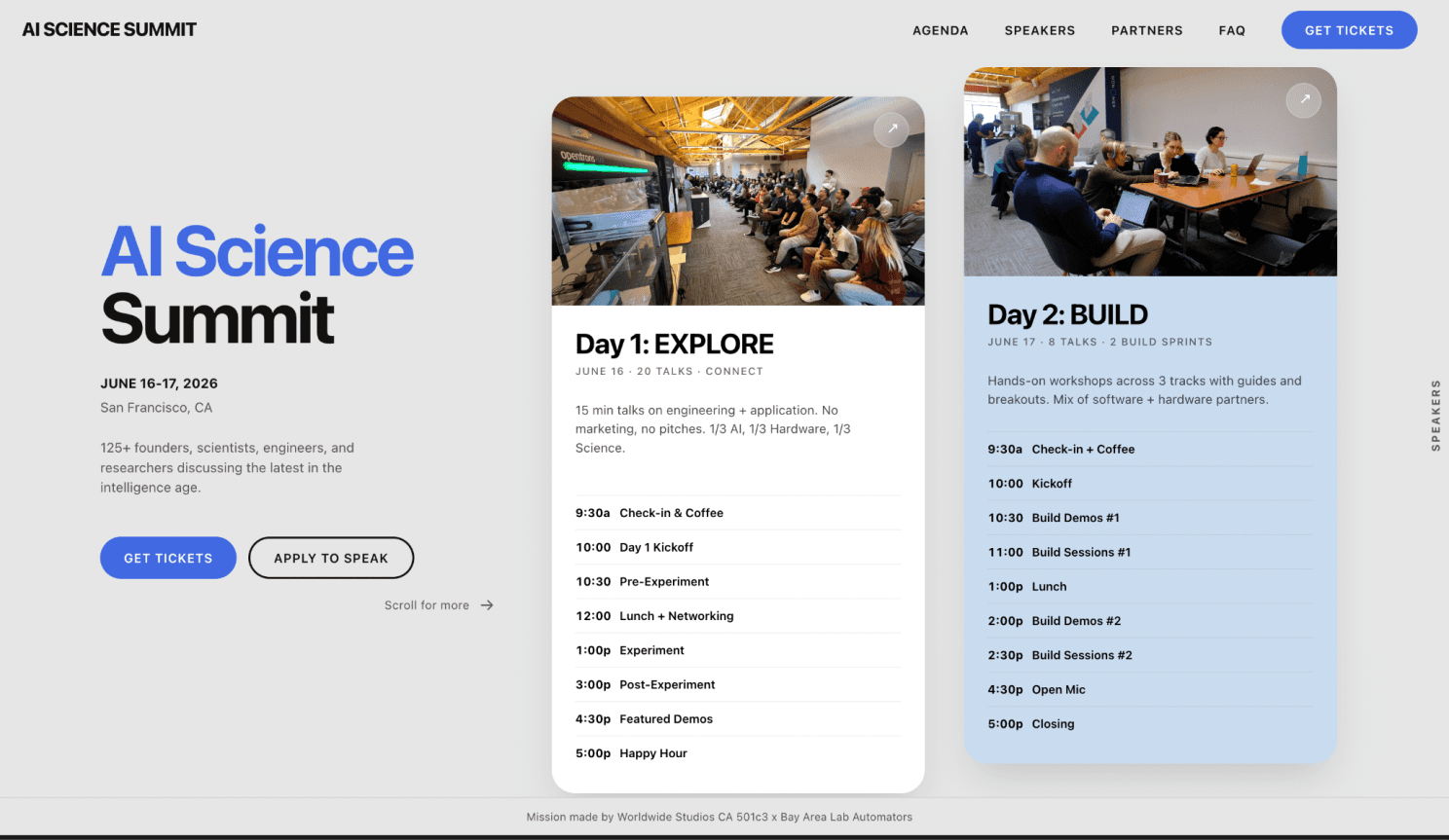
We're building toward the AI Science Summit in SF on June 16-17, 2026. If you want to help support the next generation of builders in AI science and lab automation, reach out.